
» MAGNIFICAnatomy_48page PDF (best viewed in Chrome or Firefox)
The AI story is not new, neither is the conundrum of its evolution and the consequences.
From fire to the book, and the mobile screen, humanity has undergone several profound mutations. Now AI is widely established in our lives and our futures, along with foreseeable damages and unanswered concerns. We may be thrilled or worried about such innovations but we must remember that while machines can be self-generative and able to plunder planetary resources and mine the depth of human minds and sensations, we will be left to counter rules written by machines and the class that owns them. Or perhaps we in turn may choose to dive in the mining of the machinic landfill above and below us.
Techniques belong to the realm of means and morality to the realm of ends. _ Bruno Latour, 2002
IN THE BEGINNING WAS THE COMMAND / Technologies have an a-signifying language of their own, but they know to appear first in the form of promises, always offsetting earlier ones and always reinforcing existing powers. When the machine comes with its own “voice”, as do sacred texts, we take notice. Artificial Intelligence—interestingly known as “AI”, appears as a billion personalized agents, speaking directly to us at conscious and subconscious levels. It easily may echo the voices of religious dogma and there, challenge what we feel as human “intelligence.” It is a sort of “annunciation” if not a prophecy.
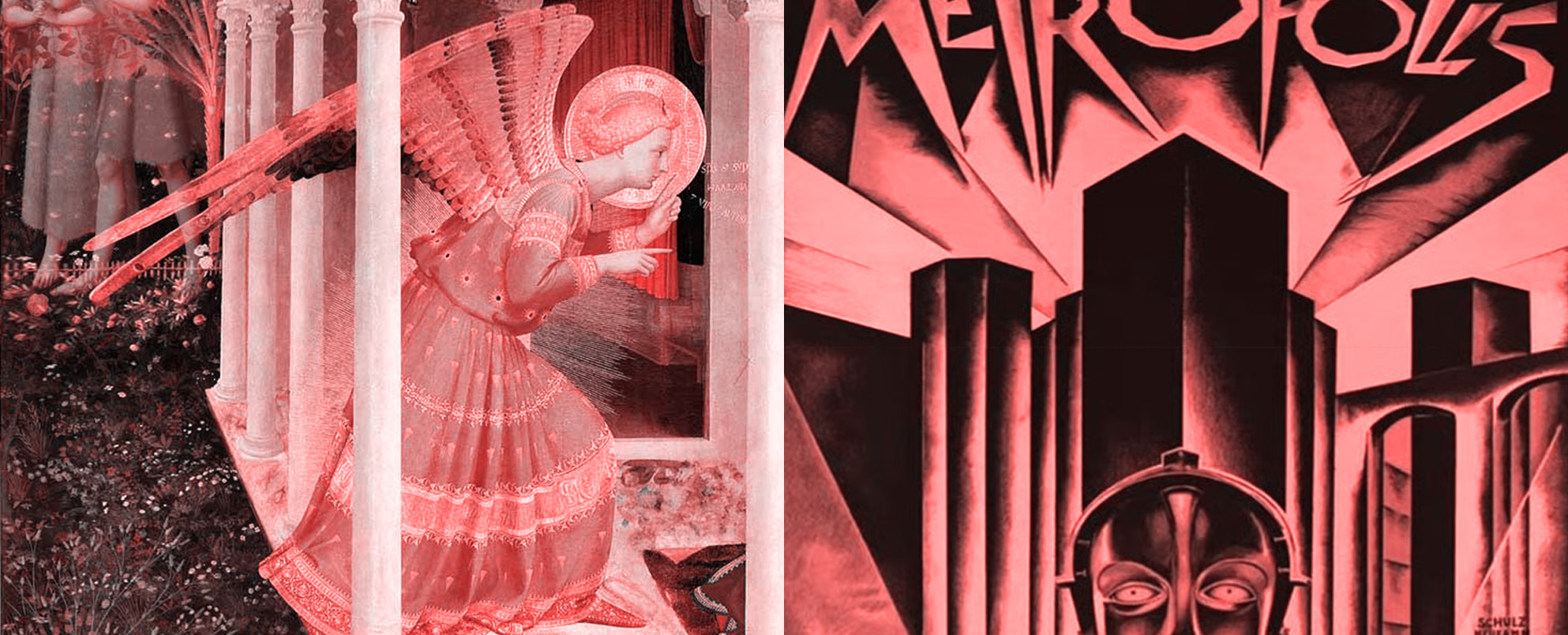
In a reverse analogy, one could argue that religions are predicated as “artificial intelligence” models in the sense that they, too, operate through formulas if not commands to define the ordering of life, its origins, and its afterlife, all the while establishing fixed societal structures. Both AI and religions seem to feed on data rooted in what we know of “the best of all possible worlds.”
For the sake of the Gospel, the 2026 Leo XIV first encyclical needed to center on AI. It predictably went viral, because 1.5 billion followers were ready to listen, but also because billions more were already pondering the becoming of humanity in what they see as a mutating world.
RISE OF THE HOMO TECHNICUS / Tools have never been neutral. They introduce elements of progress while reinforcing established orders. Confident that tools could augment our potentials while never overcoming them, we have always used them unfazed by the consequences.
As a Prometheus army, we have slowly been made to believe that our pursuit of power is conditional to design and technology. Just as pharmaceuticals have wired and rewired our physical making, we have evolved into a frenetic age of “intelligence” feeding on itself to become fully artificial. If the hammer was an extension for our fist, AI is made to convince us that it is an extension of our imagination, hence our culture. However the hammer has never been autonomous while AI is meant to literally overcome our creative capacity.
To be homo technicus today is to have joined infinitely powerful techno-entities able to grow with their own set of values, economies and rules, surely on a path of conflicts between each other — that is unless all AIs of the world could be unified.
In the long lineage of innovations, AI is a big leap for the homo technicus now empowered to create seemingly ad infinitum. Coming soon, a definitive step will introduce the super homo technicus able to self-create.
Ultimately, Man and Machine today seem to be on a parallel path where the former defines the latter that in turn serves and dominates the former. It is our new DNA.
ONE HUMANITY UNDER AI / If the separation of church and state can be seen as an ideal, we could conceive of a “state” where efficiency, wellness and social justice are fully optimized into a collective rationality while individuals are allowed optimum freedoms to explore the irrational aspects of their selves without affecting the wellness of others.
AI knows our beliefs, religious or otherwise. It knows how to listen, counsel, advise, guide, and reinforce our faith. AI knows how to target user demands, needs and weaknesses in all possible ways. It can appear or pose as organizations, doctrines, angels and demons. As such we will be caught between the certainty of countless invisible rogue agents, or the possibility of one universal AI with a constitution and set of commandments authored by humanity, for the sake of the wider living.
THE COMMONS OR THE CARTEL / A common good requires a common owner, and today’s AI has neither. It is built, trained, and steered by a handful of corporations and states whose incentives are speed and dominance, not stewardship. The billions of us who supply the data, absorb the disruption, and inherit the consequences have no seat at that table — we are the resource being mined, not the shareholders of the mine. If AI is to become, as Leo XIV hopes, a force that narrows rather than widens injustice, it cannot remain the private instrument of whoever can afford to build it. A “cognitive commons” is not a metaphor; it would require the same kind of deliberate, contested construction that public utilities, labor law, or the commons of clean water once required against the private interests that opposed them.
DOCTRINES / We are what we are prompted to believe and make. AI has inherited our means without our ends. When our creations have escaped our control to become autonomous while imposing their dominions, it is time to think by and for ourselves—a time to question the commands we are asked to follow.
The AIs of the world will themselves produce their own doctrines whether Eastern, Western or corporate models. Until we can confront what we have become, technology will not be a solution to our problems. In the face of massively imposed innovations, we the billions do not have a say, but we can still claim agency over our daily lives, if we have the will.
Leo XIV rightly sees increased injustice as a challenge worsened by the million AIs competing for our attention. Yet if we can establish an AI-powered human-centered “cognitive commons”, then technology could at last prove to be a solution. Else we may revert to the temptation of churches and temples as ultimate shelters. Regardless, our approach to theology will need to evolve to properly consider the question of the who and how of creation in the context of unlimited technological powers, the limits of scientific knowledge, and a subconscious that remains infinitely arcane — whether in Man or in the Machine. ///